Benjamin Franklin
Elite Academy

Welcome to the BFEA.
Where excellence reigns.
What is the BFEA?

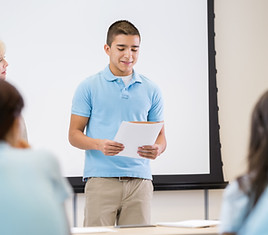
Are you a serious, mature, and intelligent 8th, 9th, or 10th grade student?
...or a parent of such a student?
If yes, then you have probably realized that your high school or middle school (similar to almost all public and private high schools) prevents you (or your child) from achieving your (or your child's) potential by...
-
Teaching at the level of the least capable students in the class,
-
Forcing you to take courses you do not need or want,
-
Requiring you to spend an arbitrary amount of time on each course and each unit of study,
-
Giving you busy work and homework you do not need,
-
Assigning you to do group work with students who are unmotivated and irresponsible,
-
Spending much time trying unsuccessfully to motivate unmotivated students,
-
Using inefficient teaching methods and low quality teaching materials,
-
Employing some incompetent teachers,
-
Not allowing you to move ahead, and
-
Wasting a lot of your time every day.

Approximately 75% of high school students in the top 15% of their class academically do not like high school and know they are not achieving their potential.
The Benjamin Franklin Elite Academy (BFEA) is a private high school for grades 9-12 that is scheduled to open in August 2026 for the 2026-2027 school year. It will be located in either Upland or Rancho Cucamonga, California.
It allows intelligent students to achieve far more than they can at a public high school or other private high school.
T'he BFEA makes this possible by...
-
Enrolling only serious, mature, and highly capable students who value education;
-
Allowing students and their parents to choose what they learn and how they learn;
-
Allowing students to soar as high as they can by getting rid of all the flaws and shackles of public and other private high schools; and
-
Operating with the traditional American values that have made the United States the most innovative, prosperous, free, and economically and technologically successful nation in the history of the human race.
At the BFEA, there are NO classes, NO mandatory courses, NO assignments, NO homework, NO meaningless grades, and NO assigned teachers. If you are a serious, mature, intelligent person, you do not need any of these to achieve greatness. They only slow you down.
How do students thrive at the BFEA?
Let us compare the BFEA to a typical public or private high school to demonstrate how the BFEA is different and superior.
Students and Environment
Other Schools
Students have varying levels of intelligence, maturity, and interest in learning. Most students do not value education which causes an environment of despondency, sarcasm, rebellion, and cynicism. Those who want to learn are often ridiculed.
Benjamin Franklin Elite Academy
Only mature, serious, and intelligent students who value education and high-level academic and practical learning are admitted to the BFEA. This creates a shared culture that celebrates learning and educational accomplishment, and it produces an environment of collaboration and purposeful endeavor. Students are inspired and encouraged by their passionate and high-performing peers to excel to remarkable heights. This gives a tremendous boost to student achievement.
What Students Learn
Other Schools
Schools have a set curriculum for all with very few electives. Teachers must teach at the lowest or close to the lowest level of student learning in the classroom.
Benjamin Franklin Elite Academy
Students, with guidance from parents and mentors, choose their own goals and what they learn. This allows students to specialize in fields of their choice, to learn important practical knowledge and skills not offered in other schools, to decide the extent of their learning for any subject, and to excel much higher than they can in other schools. For example, a student pursuing aerospace engineering may obtain a well-rounded education in various subjects but focus on math, science, and engineering so that he is able to master the third year of college physics before he graduates from high school.
Grades
Other Schools
Teachers grade some combination of assignments, homework, projects, quizzes, tests, and participation. Each teacher has his or her own grading method and system. Some teachers have high standards; others inflate grades. Not only is this confusing and frustrating, but this makes the grades meaningless. An “A” in U.S. History, for example, has little or no meaning.
Benjamin Franklin Elite Academy
There are no grades (with one exception explained in the “Outcome” section below). Instead, students earn certificates and badges.
A certificate certifies mastery of a specified set of knowledge or skills at a specified level that is clearly defined and published for all to see. This makes the certificates meaningful, unlike grades. For example, a student might earn a certificate for Level 5 Expository Writing or for Level 4 Biology, and the standards for achieving these levels will be clear and fixed. Students earn certificates by successfully passing exams that are evaluated by at least two mentors. This helps to maintain standardization of the certificates and prevents subjective grading. A student may take an exam whenever he or she is ready.
A badge certifies successful achievement or completion of a specific challenge or project. For example, a student might earn a badge for winning a math competition or for having an essay published in the school’s journal.
How Students Learn
Other Schools
Students must learn in classrooms with around thirty students of varying interests, values, and levels of intelligence and motivation. They are assigned teachers who are overworked. They are forced to participate in group work with students who have little or no motivation. They must use inferior learning materials created by busy teachers. They must complete assignments, homework, projects, and quizzes and tests that are designed for the masses and, therefore, have very little probability of helping individual students learn as effectively and efficiently as possible. And everything they do to learn - class lectures, learning activities, assignments, projects, units of study - must be completed in arbitrary time periods set by the teachers and the school. If a student needs a little more time to learn a science concept before the exam, too bad. He must test and move on. If a student learns quickly and is ready to start the next lesson, too bad. He must waste time and wait for the teacher and the rest of the class.
Benjamin Franklin Elite Academy
BFEA has no classes, no set courses, no assignments, no homework, and no assigned teachers. Students decide how they learn to earn the certificates and badges they wish to earn. With guidance from mentors, they learn how to learn effectively and efficiently. The BFEA is an exciting, vibrant, dynamic learning center. During a school day, there is a variety of great learning opportunities from which to choose, and students can create their own. A student might study alone in the library, study with a group, join a discussion, work on a project he or she designed, work with a mentor, participate in a science lab, compete in a math competition, deliver a speech or presentation, read, write, attend a lecture, view a documentary and discuss it with a group of other students, conduct research, produce a podcast or video, etc. The possibilities are endless.
Also, students can take an exam to earn a certificate and then proceed to higher learning whenever they are ready. This allows BFEA students to achieve much more learning and much higher levels of mastery than students at other schools.
Outcome
Other Schools
Students earn a diploma and a transcript of meaningless grades. They might also have years of experience with clubs, athletics, and other extracurricular activities or with employment.
Benjamin Franklin Elite Academy
Before or soon after starting their careers at the BFEA, students, with the help of parents and mentors, choose their goals, which include a clear career objective, certificates and badges they want to earn, and a resume they aim to develop by the time they graduate. Although students can make changes to their goals, the goals give students direction and challenges that guide their learning at the BFEA every day. Instead of a transcript of meaningless grades, a student graduates from the BFEA with a resume that includes certificates and badges that demonstrate real learning and mastery, as well as other components that make him or her very competitive for college admission or for employment, including work experience, real world projects and accomplishments, internships, and recommendation letters from college professors and professional experts. The BFEA does provide each student with a transcript of grades calculated based on certificates and badges earned, so students can use their transcripts for college applications.
For example, a student who focuses on journalism at a public school or other private school might complete an elective course in journalism and write for the school newspaper. At the BFEA, a student can focus on journalism and earn certificates up to a college senior level or higher, write for the academy's newspaper, publish her own podcast, publish videos, publish articles in professional publications, have a professional mentor, intern at a prestigious journalism organization, work as a journalist, and receive recommendation letters from journalism professors and professional journalists with whom she has worked. Which student will be more competitive for college admission or for employment and be more prepared to start a career in journalism?
Teachers
Other Schools
Students have no choice. They are assigned around six teachers each school year. This means students have six different “bosses” and six different grading systems. They receive assignments, homework, and tests from six different teachers with no coordination, which results in some days with relatively little work and other days with a ridiculously high amount of work leading to stress and sleep deprivation.
There are some highly notable and impactful teachers in public and other private schools. However, many teachers have low intelligence and are incompetent teachers because the teaching profession does not attract the best talent due to the relatively low wages, long work hours, and the poor work environment caused by unruly adolescents, a tragically flawed education system, and destructive policies.
Teachers are over-tasked. They must create learning units, learning materials, lesson plans, learning activities, assignments, and exams; teach five class periods each day; grade countless assignments and exams; manage around 150 students; and discipline, counsel, and babysit students. They have no time to continue to learn or to do scholarly or practical work in their fields, so they become stagnant. And they often become burned out and leave the career prematurely.
Benjamin Franklin Elite Academy
The BFEA has no teachers. Instead, we have mentors.
Mentors have strong scholarly and practical mastery in their subjects as well as extensive experience in their fields outside of teaching.
Mentors do not teach courses and class periods. They do not create learning units, learning materials, lesson plans, and assignments. They do not grade countless assignments and exams; manage around 150 students; and discipline, counsel, and babysit students. Students at the BFEA are serious, mature, and intelligent. They do not need babysitting, and they do not need to be assigned work or to be organized into six or seven class periods.
Instead, mentors mentor. They do this by doing the following:
-
Spend at least one hour each day doing scholarly work. This continually grows their academic mastery.
-
Spend at least one hour each day doing practical work in their fields. This continually improves their expertise.
-
Personally mentor six or seven students weekly.
-
Mentor other students who seek their mentorship.
-
Tutor individual or small groups of students.
-
Help students to develop and facilitate effective learning activities.
-
Conduct some learning activities, such as lectures, discussions, demonstrations, etc.
-
Initially create the exams for certificates.
-
Evaluate exams for the awarding of certificates.
Mentors are not over-worked and over-stressed like teachers. They have sustained energy and passion for learning, teaching, and mentorship.
Contact Us
(818) 521-2825
Schedule a free information session today to learn more about the BFEA and to have our representative, Jeremy Ebbink, answer your questions.
The information session will be in person at a location convenient for you.
Please complete the form below to schedule the meeting, or feel free to send us an email or give us a phone call.